
Structural Damage Identification with Neural Networks
Research on detecting, locating, and quantifying structural damage from vibration measurements using autoencoders and convolutional neural networks.
During my research program at university, I coauthored three papers investigating how neural networks can identify structural damage from vibration measurements. The work combines sparse autoencoders, convolutional neural networks, statistical analysis, and displacement measurements extracted from video.
The studies progress from detecting changes in a bridge's condition to classifying known damage states in a beam and estimating where damage occurs along its length. For an overview of the methods and results, read Detecting damage in structures by the way they vibrate.
Papers and downloads
CILAMCE 2022
Structural damage detection with autoencoding neural networks.
Resende, L. V., Finotti, R. P., Barbosa, F. S., and Cury, A. A. (2022). Proceedings of the XLIII Ibero-Latin-American Congress on Computational Methods in Engineering (CILAMCE), Foz do Iguaçu, Brazil.
Sparse autoencoders extract compact features from frequency-domain measurements of the Z24 bridge. Control charts based on the Mahalanobis distance distinguish its structural conditions.
Download CILAMCE paper (PDF, 0.6 MB)
EVACES 2023
Autoencoders and Convolutional Neural Networks Applied to Structural Damage Detection.
Barbosa, F., Resende, L., Finotti, R., Cury, A., Motta, C., Garrido, H., Domizio, M., and Curadelli, O. (2023). EVACES 2023.
A comparison of sparse autoencoders and convolutional neural networks for classifying eight structural conditions using camera-derived displacement time histories from a cantilever beam.
Download EVACES paper (PDF, 3.8 MB)
Structural Health Monitoring
Damage identification using convolutional neural networks from instantaneous displacement measurements via image processing.
Resende, L., Finotti, R., Barbosa, F., Garrido, H., Cury, A., and Domizio, M. (2023). Structural Health Monitoring. DOI: 10.1177/14759217231193102.
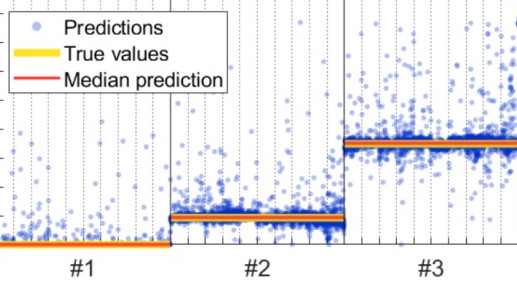
A convolutional neural network uses simultaneous displacement measurements at 60 beam positions to locate damage and estimate its severity. The study also evaluates damage scenarios withheld from training.
Download journal paper (PDF, 4.9 MB)
Cover image: CNN predictions, true values, and median predictions for structural scenarios 1, 2, and 3.